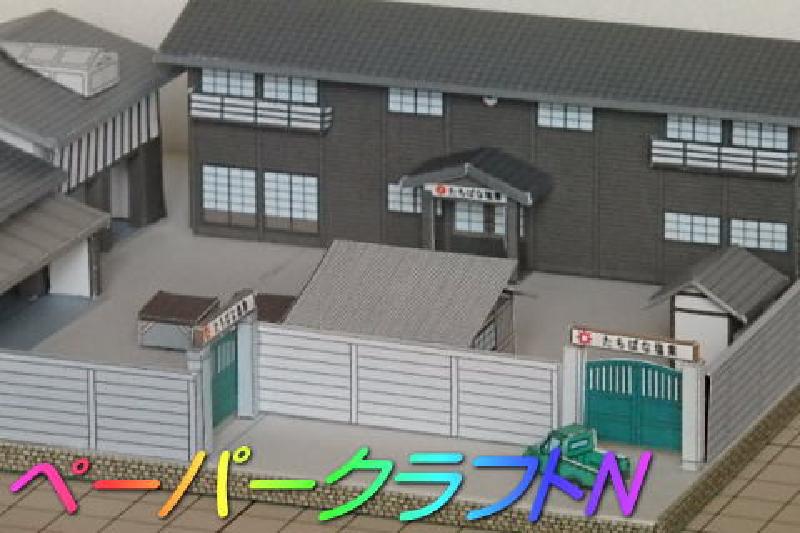
I’ve tried to recover paper structures from the former paper-n.sakura.ne.jp website through archive.org. Please see below what I’ve recovered. :) Also, the structures are in the Zip files below. If you know who I can credit for the PDFs and the paper-n.sakura.ne.jp website, please let me know so that I can credit them here. Lastly, if you have more PDFs, or know where I can find the other missing PDFs of the website, please let me know as well. I can be emailed at michael(a)balcos.net. Have fun.
No. |
Name | Photograph |
Description |
|---|---|---|---|
| C1-2 | Multi-story parking lot (American house) | 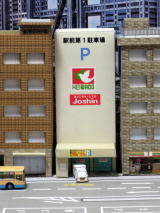 |
It is a different color model of the multi-story parking lot that was released when we first started HP. Can you do it in a work a long time ago? But. A light truck is included as a bonus. |
| C2-2 | Office building | 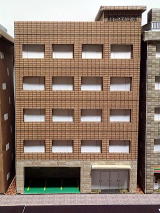 |
This is a different color version of the office building that was posted at the beginning of the HP release. |
| N16 | Farmer’s new house (Extension farmhouse house) | 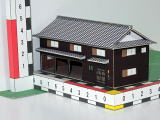 |
It reproduces a farmer’s warehouse and new house built next to the main house with thatched or thatched roofs and tin. New houses with this construction are common in the southern part of Hyogo Prefecture. ( Well, I don’t think it’s unusual in other prefectures) This time, I didn’t make a creation method because it was a little annoying. |
| N43 | Shimagata Home (Island platform) | 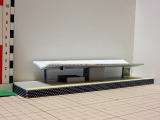 |
The model is an island-type home that seems to be found everywhere in the country. |
| N50-2 | Farmers in Miyagi Prefecture (Tin roof Ver) (Farmhouse (tin version) of Miyagi) Let’s do our best Tohoku (re) | 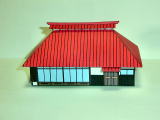 |
There are few tin roofs of farmers in Miyagi Prefecture with tile patterns that are common in the Kansai region, and the proportion of using bright tin, such as blue and red, is high. |
| N55 | Self-Defense Forces car | 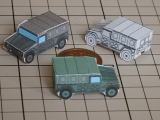 |
It is a car of the Self-Defense Forces. High-powered vehicles and trucks If you print it in postcard size, it will be an N gauge size. There is no production method or detailed explanation. |
| N56 | Small building | 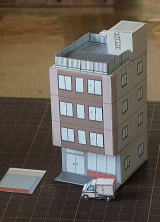 |
The model was a building in Hyogo Ward, Kobe City. But it’s a building that seems to be everywhere, not just here. |
| N57 | Sugar hut (Shed who squeezes sugar cane) | 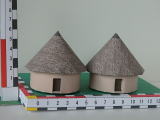 |
The model is preserved in Shikoku Village in Yashima, Takamatsu City, Kagawa Prefecture. It is a structure where the cows walk around and squeeze sugar inside, so it is a hut that is much larger than what you see at a glance, and the round roof is cute. |
| N58 | Houses with a single-flow roof (House of the pent roof) | 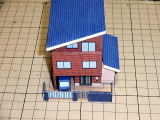 |
There is no particular model in the work, but it is a modern-style house that is everywhere. In addition, I tried to make a set of mini cars and the exterior. |
| N59 | Prefabricated house of the Showa 40s | 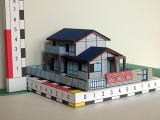 |
It is a prefabricated house from a housing manufacturer in the early 1940s. In particular, there is no model called “this house”, but 1 sweeper window with skylight 2 attached veranda are the prefabricated features of this era. |
| N60 | Reconstruction housing (housing constructed after a disaster) Let’s do our best Tohoku | 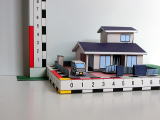 |
The model was the earthquake reconstruction house in Onagawa-cho, Oshika-gun, Miyagi Prefecture. |
| N61 | Public housing | 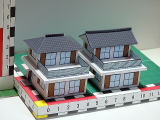 |
The model is a public housing in Omihachiman City, Shiga Prefecture, which was established at the end of the Showa period. What caught my interest was the fact that the second floor part was a tile roof, but the second floor part was a flat roof, which was a little strange and unbalanced. |
| N62 | Ise’s townhouse | 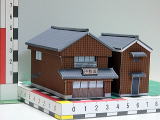 |
The model was the store in Okuyokocho in Ise Jingu and Naigu-mae. The entire cityscape is unified into the construction of Ise’s townhouses, inviting you to travel. |
| N63 | Convenience store | 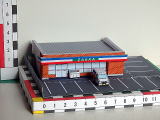 |
The model is a type of farmer that is common in northern Osaka Prefecture and eastern Hyogo Prefecture. It is an image of the early Showa 30s. This work is a very old work, so those who can do it will still have a question mark… |
| N64 | Retail store building | 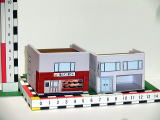 |
There is no particular model in this work. It is a set of shops that seem to be everywhere and an office building that can hold about 2 cars. |
| N66 | Machiya housing | 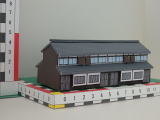 |
The model was a townhouse in Sumoto City, Awaji Island, Hyogo Prefecture. I think there are buildings like this not only here but also in the old city. In recent years, reconstruction has progressed and the number has decreased rapidly. |
| N67 | Post office | 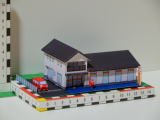 |
The model was the post office in Keyakidai, Mita City. In addition, there is a postal delivery car. |
| N72 | Bus sales office | 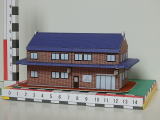 |
The model was the Awaji Kotsu Fukura Sales Office in Fukura, Minamiawaji City, in the southern part of Awaji Island. Around the sales office, there are various tourist attractions such as Naruto’s Uzumaki Kanshio Ship, Awaji Ningyo Joruri Theater, onions, fresh vegetables, fruits, seafood, and Fukura Marche, which has delicious ingredients from Awaji. About an hour and a half from Kobe Sannomiya. It is a convenient tourist destination that can be easily tripped from Osaka and Kobe, recommended! |
| N73 | Two families | 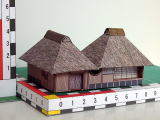 |
The model was a private house that was moved to the Reimeikan in Kagoshima Prefecture. The Futatsu family is said to be a unique architectural style in Kagoshima. In a separate building, there were many inconveniences in life, so the house was gradually built by bringing the building closer, and connecting the eaves with a large gutter. |
| N74-1 | Salt factory, office and accommodation(Saltery*The office and the lodgings) | 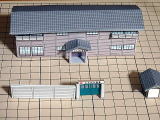 |
From this time on, it will be a series of salt factory. ( Scheduled for 4 times in total) The model was a business station that made salt, which was the setting for the morning drama “Manpuku” in the second half of fiscal 2018. I used the image board as a reference, but the actual shooting was a little different. I wonder if it can also be used as an “old school”. It is said that the setting of salt making was in the southern part of Osaka Prefecture, but the shooting took place on the coast of Amanbukue-cho, Minamiawaji City. It is a very beautiful coast and is designated as the Seto Inland Sea National Park area. It’s a beautiful beach, but swimming in the sea is strictly prohibited. It will be washed offshore by the offshore flow! |
| N74-2 | Salt factory and workshop (Saltery * Work place) | 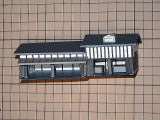 |
This is the second “workshop” of the salt factory. The inside is pretty good. |
| N74-3 | Salt factory, kiln, gate, fence (Saltery) | 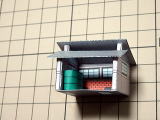 |
It is the third salt factory “kiln, gate, wall”. A few decades ago, I often saw concrete walls like this. |
| N74-4 | Salt factory and site | 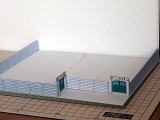 |
This is the 4th “site” of the salt factory. Please reinforce this with styrol board and use it. |
| N75-1 | Korean farmers, main house and barn | 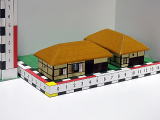 |
It is modeled on a Korean farmer in the 1920s that was moved to “Little World” in Inuyama City. Speaking of Korea, the recent anti-Japanese behavior is too much to see. Personally, I hate it… |
| N75-2 | Korean farmers, gates, fences, and sites | 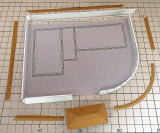 |
It is modeled on a Korean farmer in the 1920s that was moved to “Little World” in Inuyama City. Speaking of Korea, the recent anti-Japanese behavior is too much to see. Personally, I hate it… |
| N76 | Kashiwabara Jinya Taiko tower | 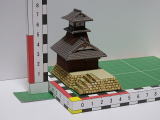 |
Kashiwabara Jinya is the castle of the Oda clan in Kashiwabara, Tanba City, Hyogo Prefecture. Until the end of the Edo period, the Oda clan, the second son of Nobunaga Oda, reigned as a lord. Even now, the lord, the Nagaya gate, and the drum tower remain in the Jinya. |
| N77 | American house | 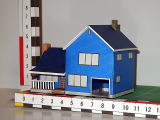 |
The model is a photo of “House of the World” published by Viebooks. In the photo, the wall was white, but the work is light blue. |
| N78 | American House 2 | 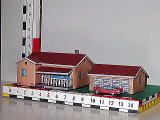 |
This house was built in the 1950s in the suburbs of Los Angeles when I was searching on the Internet to build an American-style house. The house and the garage are separate buildings. I think American home dramas were often broadcast on TV around the 1970s. Nowadays, it is not uncommon for families to have multiple private cars, but in Japan in the 1970s, there were few houses with private cars, and American houses with private cars in a large lawn garden were also “longing life”. |
| N79 | Private house in Scotland | 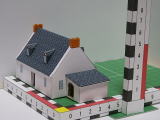 |
I referred to one of the photo books “House of the New World”. I thought it felt good," and I tried to make it. Many private houses in England are rich in regional colors and attract interest. What is the characteristic of a Scottish house? Personally, there are chimneys at both ends of the gawn roof? I wonder. " The House of the World and the House of the New World aroused a lot of creative motivation. In addition, a tractor is attached. |
| N80 | German private house | 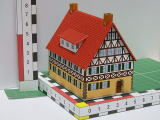 |
I traveled to Rothenburg and Heidelberg Munich, but all the houses in the old town had the atmosphere of this work. If you prepare a little more, you may have learned a lot of differences. It’s hard to go abroad, but there are buildings in Japan that feel like Germany. Kobe’s Ijinkan Street is one of them. The wind vane house and the line house below are both foreign people who have been inhabited by Germans in the past. |
| N81 | Triangle barracks and Kamaboko barracks (Triangle barracks * Quonset hut) | 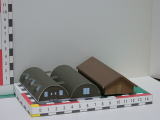 |
The triangular barracks was a semi-underground wooden barrack building with young trees for disguise on the roof. There is a restored triangular barracks next to the Suicide Peace Association Hall in Chiran-cho, Minamikyushu City, Kagoshima Prefecture. Kamaboko Barracks is a building made using a lightweight prefabricated construction method by Totan. It became widely known as an American military barracks. |
| N82 | Anne’s house with red hair (House of Anne of Green Gables) | 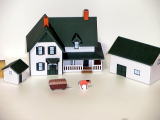 |
What I used as a reference for the creation is the collection of setting materials of Red-haired Anne that I purchased when I visited the head office of Nippon Animation about 35 years ago. Don’t worry about the small differences. The wall surface of the patterned chicken coop and barn has been modified to brown. |
| N83 | Showa’s private shop (Personal store AD1970) | 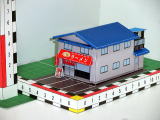 |
It is an image of a restaurant in a town around 1970 where the World’s Fair was in Osaka. These days, washing machines are just starting to come out and there are no dryers. In the house in the town, I hung the laundry on the covered veranda. It’s a building from a slightly nostalgic era. |
| N84 | British car | 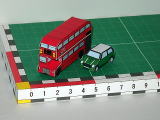 |
If you print it in postcard size, it will be an N gauge size. The patterns are “London Bus” and “New Rover Mini”. |
| N85 | European cars | 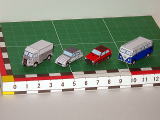 |
If you print it in postcard size, it will be an N gauge size. The patterns are “Citroen H Van”, “Citroen 2CV”, “Volkswagen Van” and “Fiat Panda” |
| N86 | American car | 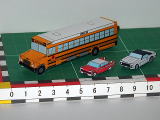 |
If you print it in postcard size, it will be an N gauge size. The patterns are “school buses” and “passenger cars from the 1950s and 70s”. |
| N87 | Japanese retro bus (Japanese nostalgic bus) | 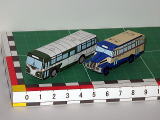 |
If you print it in postcard size, it will be an N gauge size. The patterns are “Hankyu Bus” and “Kobe City Transportation Bureau” |
| N88 | Aichi Machinery Industry’s car | 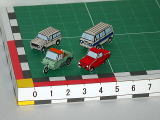 |
It’s a car about 50 years old. If you print it in postcard size, it will be an N gauge size. |
| N89 | Private house with front roof (Private house of Otari-village) | 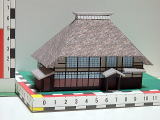 |
I am referring to a private house near Kotani Village, Nagano Prefecture. The Chikoku Kaido runs through the village, and along the road, there are ancient temples and shrines, stone Buddhas, and Taoist ancestors, leaving a landscape like the original scenery of Japan. |
| N90 | Three-story small house (3 stories small size house) | 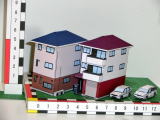 |
The reference is a small house downstream of Ichiku Dam in Kawanishi City, Hyogo Prefecture. In the past, this type of house was often seen in the urban areas of large cities, but recently it has also become common in residential areas in the suburbs. I wonder if it’s easy to live in a sense without the need to take care of the garden. |
| N91 | Pearl Farm Fisherman’s House (House of the pearl farming fisherman) | 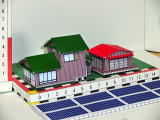 |
The model is a house in a fishing village in Uwajima City, Ehime Prefecture. There was an aquaculture shelf in front of the house, and a raft with the workshop was floating in front of it. There were several similar houses lined up and the color of the brightly colored roof stood out. After I got home, I did a lot of research and found out that it was the home of a fisherman who was farming pearls. |
| N92 | Fisherman’s hut | 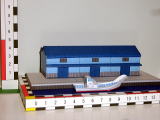 |
The model was a fisherman’s warehouse in Fukura, Minamiawaji City, Hyogo Prefecture. Around here, fishery processing industries such as ash seaweed, three-year-try trough puffer fish farming, and chirimen and ikanago are carried out. |
| N93 | Azumadachi private house (Private house of Tonami plains pref Toyama) | 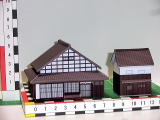 |
The model was an Azumadachi private house that is often seen in the Tonami Plain in Toyama Prefecture. Now the number has completely decreased, but you can still see houses like this surrounded by a forest of residences. |
| N94 | Kyomachiya (Traditional town house) | 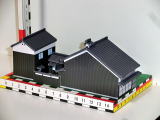 |
The model was a townhouse in Nara. However, there is no particular model for any house. 80 years ago, many of the townhouses were seen in urban areas throughout Japan, but many of them were burned down in World War II air raids. However, there are many old-fashioned townhouses like this in Nara and Kyoto, which were not air raids, and in local cities that were not urbanized. |
| N95 | Log house | 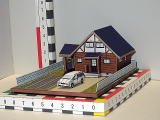 |
The model was the Goshiki Log House in Wellness Park Goshiki-cho, Sumoto City, Awaji Island. It is a building for rent, and you can stay with your family and friends. |
| N96 | Stay-type citizen farm (House with the farm for rent) | 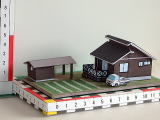 |
The model was a citizen farm with a residence for accommodation in Sasayama City, Tanba. Please see here for details. Citizen Farm (hyogo-rakunou.com) Japanese village culture |
| N97 | Agricultural Cooperative Collection Shipping Warehouse (Agricultural cooperatives shipment warehouse) | 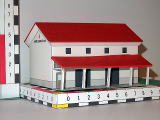 |
The model was a warehouse next to the branch of the agricultural cooperative in Nishiwaki City. Speaking of which, when the year was Showa, I saw these collection and shipping warehouses here and there. |
| N98 | Kobe bus | 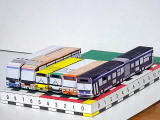 |
From this April, connecting buses began to operate in the center of Kobe City. To commemorate this? We will reveal the paper crafts of buses seen in Kobe city. |
| N99 | Fire brigade warehouse (Building of the firefighting team) | 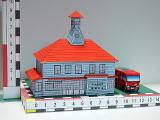 |
In the old town, there is always a local firefighting organization “Fire Brigade” that complements the fire station. This fire brigade building has various shapes. Among them, what impressed me was the building that integrated the fire view and the fire truck hangar I saw in Morioka City, Iwate Prefecture. |
| N100 | Funaya (Boat cabin) | 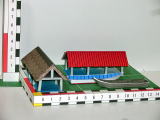 |
The model was a boathouse located on the shore of the Sankata Goko Lakes in Wakasa Bay, Fukui Prefecture. What is stored in the boathouse is a small boat that is used exclusively for transporting and shipping plums. |
| O04-2 | Shrine | 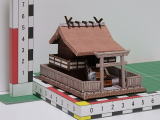 |
It’s New Year’s Day soon, so it’s not a New Year’s celebration, but I’m going to release the shrine pattern for the first time in three and a half years. It’s a very old work, so it’s not the same… |
| RA2 | Tin roof farmer 1(Red roof)(Tin roof farmhouse) | 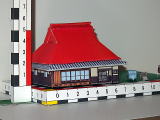 |
The model is a type of farmer that is common in northern Osaka Prefecture and eastern Hyogo Prefecture. It is an image of the early Showa 30s. This work is a very old work, so those who can do it will still have a question mark… |
| S06 | Agricultural equipment warehouse 3 (Agricultural machinery hangar) | 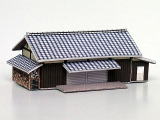 |
It is a separate version of the agricultural equipment warehouse that was previously released, and it is an image of an agricultural equipment warehouse from the 1950s to the 1960s (around 1975-1985 A.D.). Speaking of the 1950s, the food management law set the price of producer rice, and farmers also had a stable income from rice farming. By the way, at this time, my family was eating “standard price rice”. These days, it was normal for individual farmers to have a complete set of agricultural equipment necessary for rice farming. |